Full & Partial Rewires
House Rewire. Done in 8 Days.
A 3-bed semi runs €7,000–€12,000 and 5–8 working days. But before you price a rewire, it’s worth knowing whether you need one, because for a large share of Irish houses, the honest answer is no.
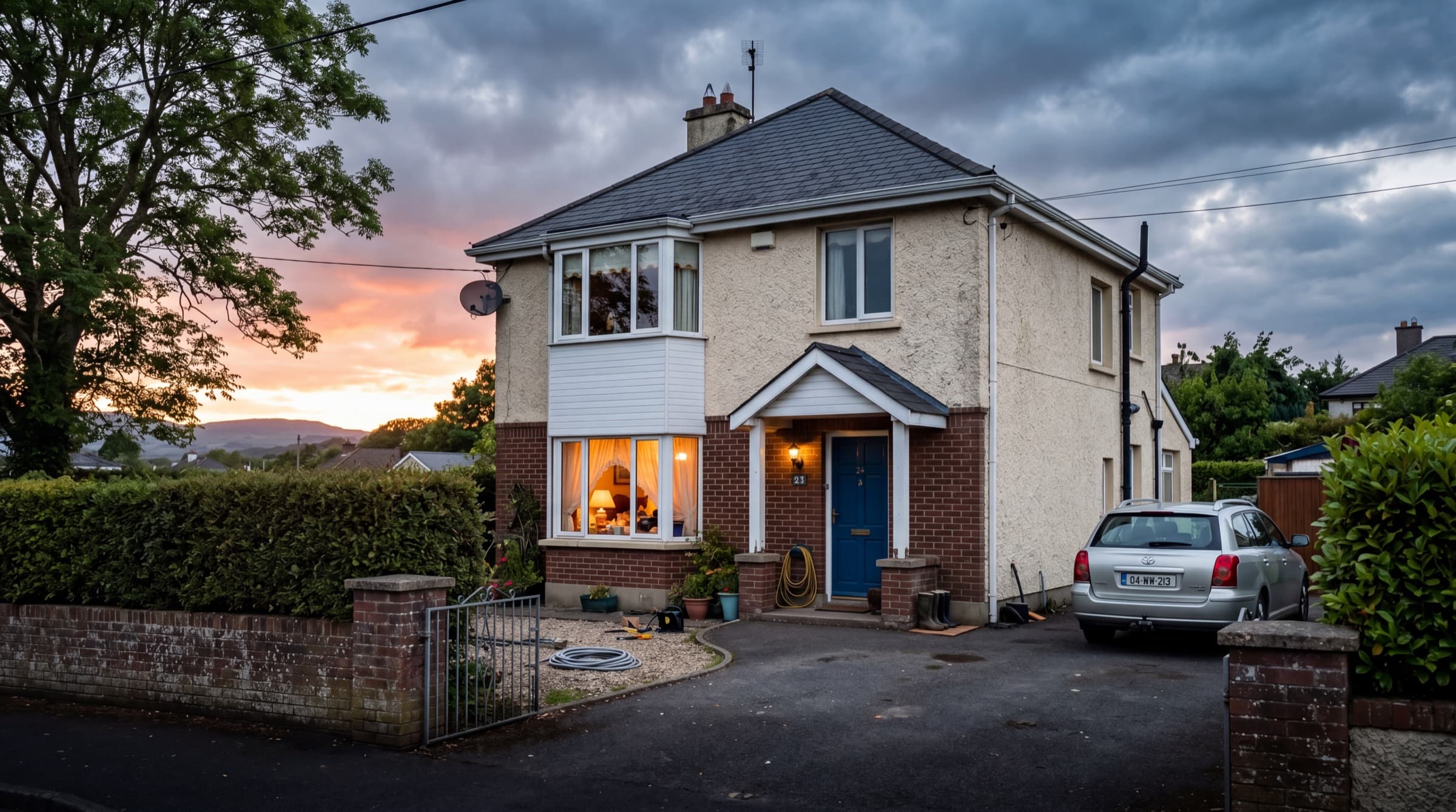
Full rewires and fuse board upgrades. Certified the day we finish.
Start Here
When your house was built decides the job
“Do I need a rewire?” has no single answer, and most pages that try to give one end up describing the oldest housing stock and letting everyone else assume it applies to them. It usually doesn’t.
The wiring rules are national: one standard, IS 10101, and one regulator. What actually changes the job is the decade the house was wired: the cable type, whether there’s an earth on every circuit, what kind of board it lands in, and how much load it was ever designed to carry. Find your era below.
Not sure which era yours is, or the house has been extended more than once? The Rewire Checker asks nine questions and gives you a verdict in two minutes, free and without asking for contact details first.
The Package
What’s Included
Full house rewires, every circuit replaced and upgraded
Partial rewires where testing shows only part of the house needs it
Fuse board (consumer unit) replacement with per-circuit RCBO protection
New circuit design sized for how the house is actually used now
Smoke and carbon monoxide detector installation, interlinked
Safe Electric testing and certification on completion
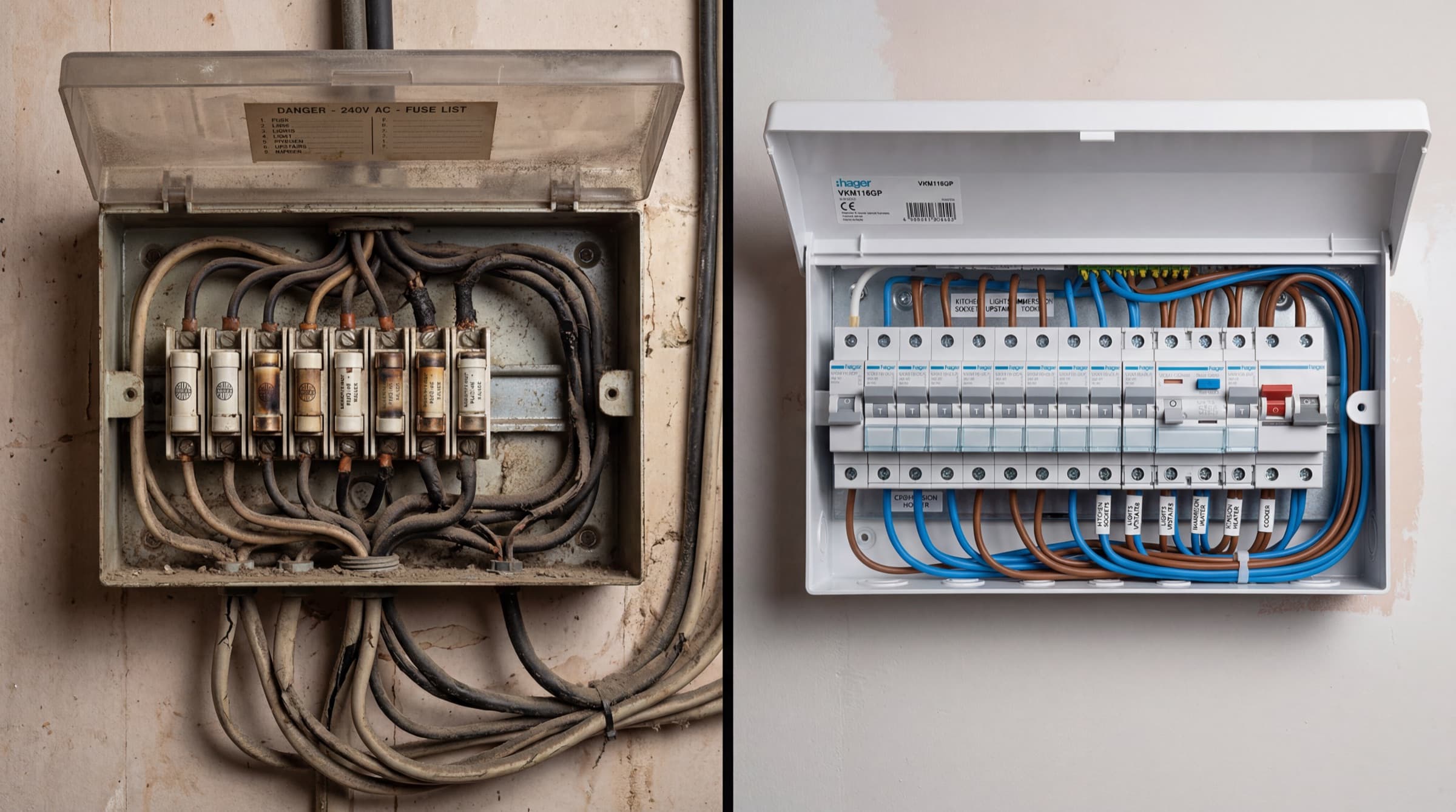
From a 1980s Fuse Board to a 2026-Compliant Install in Days, Not Weeks.
Old rewireable fuses become surge-protected RCBOs. Black rubber cabling becomes new twin-and-earth on Hager VKM busbars. Every circuit tested, every label written, every certificate filed. You go from 'insurance might decline a claim' to 'fully Safe Electric compliant' in the time it takes most contractors to write a quote.
The Plain English Version
What actually happens in a house rewire
A rewire is a strip-out and replacement of every cable, socket, switch and the fuse board. We lift floorboards, chase channels into the walls for new back boxes, pull fresh twin-and-earth through the joists, and terminate everything into a new consumer unit fitted with RCBOs, one breaker per circuit, each with its own earth-fault protection. When we button it back up you have new wiring from the meter to the last socket: not patched, not extended, replaced.
A partial rewire is the same work on part of the house. It is the right answer more often than it gets offered: a sound upstairs with a failed kitchen run, or an uncertified extension spurred off whatever circuit was nearest. Some contractors won’t quote partials because a full rewire is simpler to price. We will, and the test results decide it rather than the calendar.
Everything we install meets IS 10101, the national wiring rules published by the NSAI in 2020, which replaced the previous ET 101 standard. When the last circuit is tested we file the completion certificate with Safe Electric and you get it the same day. That is the document your solicitor asks for on a sale, your insurer asks for after a claim, and a buyer’s surveyor asks for at the survey.
Worth naming the thing people worry about most, which is not the wiring: it is the mess. Chasing walls produces a lot of fine dust and that is the part that surprises people. We sheet up, work room by room, and tidy at the end of every day. But we can’t make chasing dust-free, and anyone who tells you otherwise hasn’t done it.
What It Costs
Prices, and what actually moves them
We publish real ranges rather than hiding behind “contact us for a quote”, but they are a guide, not a quote. Every house is different. The accurate number comes after we’ve tested the installation, and what you get then is a fixed written price that doesn’t move once the floors are up. All figures include VAT and the Safe Electric certificate.
| Work | Typical range | What moves the price |
|---|---|---|
| Fuse board upgrade: standard 3-bed | €350 – €600 | Number of ways, board position |
| Fuse board upgrade: larger home, more circuits | €900 – €1,400 | Surge protection, relocation |
| Additional circuit (EV, shower, garage) | €100 – €300 each | Cable run length, spare capacity |
| Partial rewire: targeted circuits only | Quoted from test results | How many circuits actually fail |
| Full rewire: 3-bed semi | €7,000 – €12,000 | Spec, making good, occupied or empty |
| Full rewire: smaller (2-bed terrace, apartment) | Typically below the 3-bed range | Fewer circuits, easier access |
| Full rewire: larger or rural (4-bed, bungalow, farmhouse) | Typically above the 3-bed range | More circuits, solid walls, outbuildings |
The biggest variable is the one you control: spec. How many sockets per room, how many light points and switches, whether you want data points run to the bedrooms and the office, outdoor sockets, an EV way in the board, USB outlets, smart switching. A rewire specified to the minimum and the same house specified generously are genuinely different jobs, and that is most of the spread in the range above. It is worth deciding what you actually want before you collect quotes, otherwise each quote is pricing a different house.
After spec, it is making good. It is almost always making good. Chasing channels into solid walls for new back boxes leaves damage that has to be replastered and redecorated, and whether that sits in the electrician’s price or gets handed to you afterwards can be thousands of euro on an identical house. Ask every quote you get whether making good is included. It is the single biggest reason comparable houses produce non-comparable numbers.
Partial rewires are often the cheaper honest answer. Where testing shows sound circuits upstairs and a failed kitchen run, replacing the failed part and certifying it properly costs a fraction of a full rewire. Some contractors won’t quote them because a full strip-out is simpler to price.
The figures above are indicative ranges for guidance only. They are not a quote and not an offer. Rewiring varies enormously with floor construction, wall type, circuit count, access and the condition of what is already behind the plaster, and none of that can be judged from a photograph or a phone call. Jamie gives you an accurate fixed price in writing after the installation has been tested.
Six things that move the number
Size and layout
Circuit count drives labour more than floor area does. A four-bed with two bathrooms, an ensuite and a converted attic has far more circuits than a four-bed bungalow of the same square footage.
Occupied or empty
An empty house is faster and cheaper. Working around a family means room-by-room sequencing, keeping circuits live overnight, and tidying every evening. All of that is real time.
Chasing and making good
Cutting channels into solid walls for new back boxes is the messiest and most variable part of the job. Whether replastering and decorating are in your quote or someone else's is the single biggest reason two quotes differ.
Floors and access
Lifting floorboards is straightforward. Semi-solid or engineered floors that can't be lifted without damage mean a different cable route and more time.
Spec
Sockets per room, outdoor circuits, EV provision, surge protection, smart switching. This is the part you control, and it is worth deciding before you compare quotes rather than after.
What's already there
A sound board that only needs new circuits landed on it costs nothing extra. A board that's full, or in a bad position, or needs the supply upgraded, does.
For a full breakdown with worked examples, read what a house rewire costs in Ireland. If your board is the issue rather than the wiring, the fuse board upgrade cost guide covers that job on its own.
Why Us
How we run a rewire
We test before we quote
Insulation resistance, earth continuity, loop impedance and RCD trip times, circuit by circuit. It takes about twenty minutes and it is the difference between a recommendation and a guess. You get the readings themselves rather than just a verdict, including when they show you don't need the work.
8-Day Full Rewire, Proven
We completed a full house rewire for a family with a newborn in eight days. Fuse board upgrade, new wiring throughout, every circuit tested and certified. You stay living in the house while we work. We power down one circuit at a time, not the whole board.
Certified and Compliant
Every rewire is completed to IS 10101, the current national wiring rules, by our Safe Electric registered team. Your certificate is in your hand the day we finish. It is the document your solicitor asks for on a sale and your insurer asks for after a claim.
Start to Finish
Test first, quote second
Test first
Circuit-by-circuit testing before any quote. Twenty minutes on site tells both of us whether this is a rewire, a partial, or just a board.
You see the readings
Not a verdict. The actual numbers per circuit and what each one means, including the ones that pass.
Itemised written quote
Board, circuits, accessories and making good are each priced separately, so you can stage it or cut spec knowingly.
The work
A 3-bed semi runs 5–8 working days. You stay in the house. One circuit down at a time, fridge and a set of lights live overnight, tidied at the end of every day.
Test, certify, hand over
Every circuit tested and recorded, the completion certificate filed with Safe Electric and handed to you the same day.
Who You’re Dealing With
Why this job is safe with us
J Cowman Electrical Contractors has been Safe Electric registered since 2021, with 5 years of certified installations behind every job we quote.
Safe Electric registered
Registration A6700
Verifiable on the public register
Public liability insurance
Up to €6.5M
Cover in place on every job
Crew size
10 electricians
Trading since 2021
Fixed-price quote
Within 48 hours
WhatsApp replies within the hour, Mon–Fri
Not sure if your house needs a rewire?
Answer 9 quick questions and get a personalised verdict in under 2 minutes.
Free · No signup · You see your result before we ask for any contact details.
Questions
House rewires: what we get asked
How do I know whether I need a full rewire or just a fuse board upgrade?
The house's age is the strongest first indicator, which is why this page routes by era rather than giving one answer. Broadly: pre-1961 houses usually need a rewire, 1961–1990 depends on what testing shows, 1991–2010 almost never needs one, and post-2011 needs added capacity rather than replacement. But age is an indicator, not a diagnosis. The answer lives in the test results. Insulation resistance, earth continuity and RCD trip times either pass or they don't. We test before we quote, and we tell you when the answer is the cheaper one.
How long does a full rewire take?
A typical 3-bed semi is 5 to 8 working days with a team of two. Larger homes take longer, and an occupied house takes longer than an empty one because we sequence room by room rather than opening the whole place up at once. We give you a day-by-day plan with the quote so you know which rooms are affected when. The 8-day figure we quote is a real job: a full rewire for a family with a newborn, completed in eight days including the board.
Can you rewire while we still live in the house?
Yes, and most of our rewires are done that way. We work room by room and keep at least one circuit live overnight so the fridge, freezer and a set of lights stay on. Power goes down per circuit for a few hours at a time, not whole-house for days. It is more disruptive than an empty house and it takes a little longer, but it is entirely normal and it saves you the cost of moving out.
What does a rewire actually cost?
€7,000 to €12,000 is a realistic range for a 3-bed semi, and the spread is genuine rather than vague. Size and circuit count, occupied or empty, whether chasing and making good are included, floor type and spec all move it. A fuse board upgrade on a house with sound wiring is €350 to €600, or €900 to €1,400 for a larger home. That gap is why it is worth establishing which job you actually need before comparing quotes. All figures include VAT and the Safe Electric certificate.
Why do rewire quotes vary so much?
Because they are often quoting different jobs. Published Irish rewire prices run from about €4,000 to over €20,000, which is too wide to be useful. The commonest hidden difference is making good. One quote includes replastering and decorating after chasing, the next doesn't, and that alone can be thousands. The second commonest is the board: included or extra. Ask every quote to itemise labour, materials, board, and making good separately, and the comparison becomes possible.
What's included in the price?
Cable, back boxes, switches, sockets, the consumer unit and its RCBOs, all testing, and the Safe Electric certificate. Light fittings and decorative accessories are quoted separately because they are a choice rather than a fixed cost. Making good (replastering and decorating after chasing) is itemised explicitly on our quotes rather than buried, so you can see it and decide whether you want it in or out.
Do I need to be off-grid during the rewire?
No. We power down per circuit rather than the whole board, so it is typically one circuit off for a few hours at a time. The exception is the day the consumer unit is changed over, which needs the main switch off for the few hours it takes to swap and test the board back in. That is usually a morning, back on the same evening. We tell you which day that is in advance.
Will my house be destroyed?
It will be messy while it's happening. Chasing channels into walls for new back boxes produces a lot of fine dust, and that is the part people underestimate rather than the wiring itself. We sheet up, work room by room, and tidy at the end of every day. What we cannot do is make chasing dust-free. If your walls are solid rather than stud, ask any quote you get whether replastering is included. That answer tells you a lot about how the job will actually go.
Do I need a rewire to sell my house?
There is no rule requiring one. What happens in practice is that a buyer's surveyor flags an older installation, the buyer's solicitor asks for an electrical certificate, and the sale slows while that gets sorted under a closing deadline. Getting a test done before the house goes on the market turns that from a chain-holding emergency into a small planned job. It often shows the installation is fine, which is worth knowing before a buyer's surveyor gets to decide the narrative.
Do you do partial rewires?
Yes, and we recommend them where the testing supports it. Some houses have sound circuits upstairs and a failing kitchen and utility run, or an uncertified extension spurred off whatever was closest. Replacing the failing part and leaving sound cable in place is legitimate work, properly certified. Some contractors won't quote partials because a full rewire is simpler to price. We will, and the test results tell you which one you're looking at.
Are you registered, and what does that actually cover?
J Cowman Electrical Contractors is Safe Electric registered under A6700, which you can verify on the public register rather than taking our word for it. We carry public liability insurance up to €6.5M and have been trading since 2021 with a crew of ten. Every installation is completed to IS 10101 and the completion certificate is filed and handed over on the day the work finishes.
Keep Reading
Related guides, tools and services
From a Single Rewire to Full Developments: Send Us the Details.
Send us your plans or a quick description. We return a fixed-price quote within 48 hours, no obligation, no sales calls.