Commercial Electrical
Commercial Electrical. Certified, Documented, Handed Over.
Power, data, lighting, emergency systems and fire alarm as one coordinated package, and the paperwork that has to exist before your insurer, your fire officer or your landlord will accept the building. A 10-strong crew that has delivered a 90-unit development, certified unit by unit.
Registered with Safe Electric · Compliant with I.S. 10101 · Periodic inspection per HSA guidance · Public liability up to €6.5M
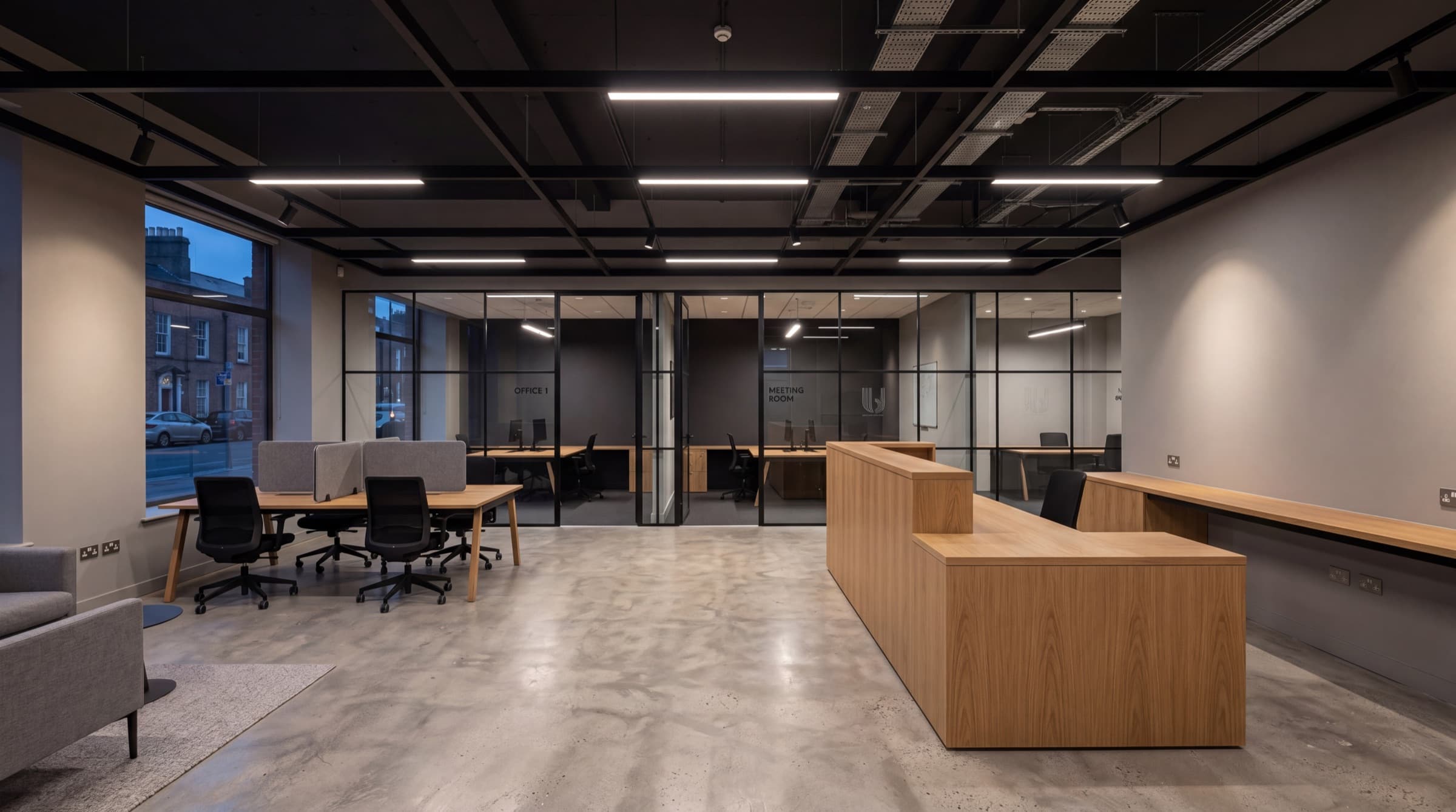
Commercial fit-out: power, data, lighting, emergency systems, fire alarm. One package, one certification pack.
Capacity
The question behind every commercial enquiry is whether we can actually carry it.
It is a fair question and it deserves a specific answer rather than an adjective. The largest electrical package we have completed is a 90-unit residential development in Dublin, covering first fix through to Safe Electric certification on every single unit.
What that proves is not that we can wire a big building. It is that we can do the same job 90 times without the standard drifting, produce 90 sets of test results that stand up to validation, and keep all of it moving alongside every other trade on a live programme. Repeatability under programme pressure is the thing commercial work actually asks for, and it is the thing a one-off job never tests.
90
Units Certified
What scale changes
Resourcing is planned, not improvised
A 10-strong crew means we can put four on a fit-out and hold the rest on other work, or put the whole team on a compressed programme. The number you get told at quote stage is the number that turns up.
Certification is a process, not an afterthought
Ninety completion certificates do not get produced in the last week. Testing runs alongside the install, unit by unit, so the documentation is finished when the work is.
We have worked inside someone else's programme
On a development the electrical contractor is never the one setting the dates. Fitting around blocklayers, plasterers and kitchen fitters without losing your own sequence is a learned skill.
One point of contact throughout
You deal with Jamie for the duration. No account manager between you and the person who can actually change what happens on site tomorrow.
Certification
There is more than one Completion Certificate, and the wrong one will not energise your building
The Electricity Regulation Act 1999, as amended, makes it mandatory for a Registered Electrical Contractor to issue a Completion Certificate for all electrical works other than minor works, and minor works still have to be certified if the customer asks. That much most people know. What catches commercial clients out is that there are four different certificates, and which one applies depends on the size of the supply and whether you are connecting or altering.
| Certificate | Applies to | What it is for |
|---|---|---|
| Certificate No. 1 | New installation under 50 kVA | Connecting a new installation below 50 kVA to the ESB Networks distribution system. The cert most small retail units, cafés and single-storey offices need. |
| Certificate No. 2 | New installation 50 kVA and above | The same job above the 50 kVA threshold. A larger connection is a different ESB process on a longer lead time, which is why the load calculation belongs at design stage rather than at commissioning. |
| Certificate No. 3 | Alterations, additions and extensions | Changes to an installation that already exists and already has a supply. Cannot be used to obtain a connection or a re-connection from the network, which is the single most common paperwork trap on a refit. |
| Interim Certificate | 50 kVA and above, phased | Lets the main distribution board be energised so a completed subsystem such as a lift, a plant module or a floor can be tested and commissioned before the rest of the building is finished. |
The trap worth knowing about. A Certificate No. 3 covers alterations, additions and extensions to an existing installation, and it explicitly cannot be used to obtain a connection or a re-connection from the network. If a unit has been sitting empty and the supply has been taken out, the paperwork you need is a Certificate No. 1 or No. 2, and that means the whole installation has to be inspected and tested rather than just the part you changed. Finding that out at commissioning stage is how an opening date slips.
Full detail on what testing involves and what the documentation looks like is on our testing and certification page.
Periodic Inspection
Re-testing a commercial installation is a legal duty, and it is yours rather than your electrician’s
This is the part of commercial electrical compliance that most business owners have never had explained to them. Regulation 89 of the Safety, Health and Welfare at Work (General Application) Regulations 2007 places the duty squarely on the employer: an existing electrical installation must be tested by a competent person “from time to time where required having regard to the nature, location and use of the installation”, defects found must be rectified promptly, and a report of the test must be completed by the person who carried it out.
Note what that wording does not do. It does not give you an interval. Irish law deliberately sets no fixed period for a general commercial installation, because a laundrette and a first-floor office do not deteriorate at the same rate. The interval is supposed to come out of a risk assessment of your own premises: its age, its condition, who uses it, how heavily and in what environment.
What does exist is guidance. The Health and Safety Authority publishes suggested periods between inspections by premises type, and in practice that table is what insurers and auditors benchmark against.
| Premises type | Visual check | Inspection & testing |
|---|---|---|
| Offices, shops and commercial premises | 1 year | 5 years |
| Restaurants, hotels and public houses | 1 year | 5 years |
| Hospitals and educational premises | 1 year | 5 years |
| Industrial premises | 1 year | 3 years |
| Leisure complexes, cinemas and theatres | 1 year | 3 years |
| Petrol stations | 1 year | 3 years |
| Laundrettes | 1 year | 1 year |
| Marinas | 4 months | 1 year |
| Construction sites | 3 months | 6 months |
Suggested intervals from the Health and Safety Authority guidance note on periodic inspection and testing of electrical installations. These are guidance, not statutory maximums.
The exceptions where the interval really is fixed
If you store fuel, the guidance stops being guidance. Regulations made under the Dangerous Substances Act 1972 set hard statutory intervals: retail and private petroleum stores at least every three years, petroleum bulk stores at least every twelve months, and oil jetties at least every fifteen months. Those are deadlines, not recommendations.
Life Safety
Three systems that are not covered by your electrical certificate
Fire alarm, emergency lighting and intruder alarm each sit outside the general electrical certification regime and are governed by their own Irish standards. They are certified separately, serviced separately, and asked for separately by whoever is signing off your building. A commercial handover stalls on this more often than it stalls on the power.
Fire detection and alarm
IS 3218Designed, installed, commissioned and certified to its own standard, with its own certificate and its own service regime. A general electrical completion cert does not cover it, and a fire officer or insurer will ask for the IS 3218 paperwork by name.
Emergency lighting
IS 3217Escape-route lighting is a design calculation rather than a fitting count: coverage at the right lux levels along the escape route, at every change of direction, at every exit and at every fire point. It is certified separately and tested on its own cycle.
Security and intruder alarm
IS-EN 50131Graded to the risk of the premises and governed by its own European standard. It shares containment and power with the rest of the installation, which is why it belongs in the same coordination exercise even when a specialist installs it.

Most commercial fit-outs fail at the seams, not in the middle.
Lighting goes in under one package, data under another, emergency systems get retrofitted when someone notices they are missing. Each trade is fine on its own and the building still fails handover, because nobody owned the boundaries: the containment shared between power and data, the emergency circuits that have to survive a mains failure, the fire alarm interface that shuts down the ventilation. We take the whole electrical scope as one package precisely so those boundaries have an owner. One programme, one certification pack, one number to ring when something needs attention.
The Package
What’s Included
Complete electrical package for office, retail, hospitality and light-industrial units
Small power, distribution boards, sub-mains and containment
Structured data cabling coordinated with the power layout, not retrofitted around it
Emergency lighting designed to IS 3217 and certified separately
Fire detection and alarm to IS 3218, commissioned and handed over with its own documentation
Commercial EV charging: three-phase and multi-bay, load-managed
Safe Electric Completion Certificate, full test results and as-built documentation on handover
Live Premises
Working around a business that is still trading
A refit in an occupied building is a different job to a shell fit-out, and the difference is not the electrical work. It is the isolation planning. Every circuit that comes out of service takes something with it (a till system, a cold room, a server, an access control door) and the cost of finding that out at the moment you switch off is far higher than the cost of establishing it beforehand.
So we walk the existing distribution boards with your facilities or store manager before anything is scheduled, agree what goes down and when, and work the sequence around your trading hours rather than ours. Out-of-hours working costs more per hour. It almost always costs less than a day of lost trade, and it is worth pricing both ways so the decision is yours with real numbers in front of you rather than an assumption.
Where the existing installation has no up-to-date drawings, which is most refits, the honest position is that some of it has to be traced on site. We would rather build that into the programme at the start than discover it in week three.
Pricing
Why we don’t publish a commercial price list
On our domestic pages we publish real ranges, because a three-bed semi rewire is a comparable job from one house to the next. Commercial is not. The same floor area can differ by a factor of three depending on the density of the fit, the size of the incoming supply and what the previous tenant left behind. A published “from” figure for commercial work would be a marketing number rather than a useful one, so we would rather tell you what actually moves the price and then price your specific job.
Send drawings or a specification and you get a fixed price within 48 hours. For a refit over an existing installation we will want to walk the unit first. The cost is behind the ceiling grid, not on the drawing.
Floor area and the density of the fit
A 200 m² open office and a 200 m² restaurant are not the same job. Socket count, small-power density, catering loads and the number of lighting circuits move the price far more than the floor area on its own.
The size of the incoming supply
Whether the installation lands under or over 50 kVA changes the certificate, the ESB Networks process and the lead time. An existing supply that has to be upgraded is a separate cost and a separate programme item.
What is already in the building
A shell-and-core unit is a clean run. A refit over a previous tenant's installation means stripping out, tracing what stays live, and working around containment that was never drawn. The unknowns are behind the ceiling grid.
Life-safety systems in or out
Fire alarm, emergency lighting and their certification are a distinct package. They are frequently left out of a cheap-looking quote and then appear as a variation four weeks before opening.
Live premises and out-of-hours working
Working around trading hours costs more per hour and takes more calendar days, but it protects the revenue the shutdown would have cost. That trade-off is worth pricing both ways before you decide.
Programme compression
Two electricians over six weeks and six electricians over two weeks are different numbers. If the opening date is fixed and the preceding trades have run over, resourcing up is possible, but it has to be priced honestly rather than promised free.
Any figure discussed before a site visit or a drawing review is indicative and for guidance only. It is not a quote and not an offer. Commercial electrical costs vary substantially with supply capacity, fit density, the condition of an existing installation and programme constraints, none of which can be judged from a phone call. The fixed price comes in writing once we have the drawings or have walked the unit.
Who You’re Dealing With
Why this job is safe with us
We deliver full electrical packages from first fix to final cert, including a 90-unit residential development in Dublin, certified unit by unit. The same crew and the same standard run a one-off house.
Safe Electric registered
Registration A6700
Verifiable on the public register
Public liability insurance
Up to €6.5M
Cover in place on every job
Crew size
10 electricians
Trading since 2021
Fixed-price quote
Within 48 hours
WhatsApp replies within the hour, Mon–Fri
Largest completed package
90-unit residential development, Dublin
Full electrical package, first fix to completion · Completed 2026
Related
Where to go next
Have drawings or a spec ready?
Send them over and we come back with a fixed price within 48 hours. WhatsApp is usually fastest, and it takes attachments.
FAQ
Commercial Electrical: Common Questions
Do we legally need an electrical certificate for our commercial unit?
For work carried out, yes. The Electricity Regulation Act 1999, as amended, makes it mandatory for a Registered Electrical Contractor to issue a Completion Certificate for all electrical works other than minor works, and minor works must still be certified if you ask for them. That is a duty on the contractor, not on you, but it is the document your insurer, your landlord and your fire officer will look for. Periodic re-testing is a separate duty and it falls on you as an employer.
How often does a commercial installation have to be re-tested?
Irish law does not set a fixed interval. Regulation 89 of the Safety, Health and Welfare at Work (General Application) Regulations 2007 requires an employer to have an existing electrical installation tested by a competent person 'from time to time where required having regard to the nature, location and use of the installation', with a written report. The Health and Safety Authority publishes suggested intervals: five years for offices, shops, hotels and pubs; three years for industrial premises; six months for construction sites. Those are guidance, not a statutory maximum, and the actual interval should come from a risk assessment of your premises.
Are there premises with a hard legal interval?
Yes, a small number. Regulations under the Dangerous Substances Act 1972 set fixed intervals for fuel storage: retail and private petroleum stores at least every three years, petroleum bulk stores at least every twelve months, and oil jetties at least every fifteen months. If you hold fuel on site, those are statutory deadlines rather than guidance.
Our supply was disconnected. Can you just issue a cert to get it back on?
Not with a Certificate No. 3. That certificate covers alterations, additions and extensions to an existing installation and it explicitly cannot be used to obtain a connection or a re-connection from the network. A re-connection needs a Certificate No. 1 or No. 2 depending on the size of the supply, which means the installation has to be inspected and tested as a whole rather than just the part that changed. It is worth knowing before you are told at the last minute.
Do you take on small commercial fit-outs or only large ones?
From a single-unit shop refit to a multi-unit development. We run a 10-strong crew, so we resource to the job rather than turning down anything that does not fill a month. The largest electrical package we have completed is a 90-unit residential development in Dublin, certified unit by unit. That is the ceiling rather than the entry point.
Can you work around our trading hours?
Yes. Out-of-hours and phased working is normal on a live premises, and we plan the isolations with your site or store management before anything comes out of service. The point is not that we work quietly. It is that you know in advance which circuits go down, for how long, and what stays live.
Who certifies the fire alarm and the emergency lighting?
They are separate certifications to separate standards, IS 3218 for fire detection and alarm and IS 3217 for emergency lighting, each with its own commissioning documents and service cycles. We install and hand over both as part of the package. What matters at handover is that the documentation for each exists as its own pack, because that is how the fire officer and the insurer will ask for it.
Can you price a job from our M&E drawings?
Yes, and that is usually the fastest route. Send the drawings or the specification and we come back with a fixed price within 48 hours. For a refit over an existing installation we will want to walk the unit first, because the cost sits in what is behind the ceiling grid rather than in what is on the drawing.
Do you install commercial EV charging?
Yes. Three-phase and multi-bay installations for workplaces and customer car parks, including the load management that stops a bank of chargers overwhelming the incoming supply. Workplace charging is a different design problem to a home charger, and the supply capacity is normally the deciding constraint rather than the chargers themselves.
What area do you cover for commercial work?
We are based in Wexford and cover Leinster. For a fit-out with a fixed opening date we put a crew on site for the duration rather than travelling daily, which is why distance is rarely the deciding factor on a commercial job.
From a Single Rewire to Full Developments: Send Us the Details.
Send us your plans or a quick description. We return a fixed-price quote within 48 hours, no obligation, no sales calls.