Domestic Electrical
Domestic Electrician, Leinster. Start With What You Noticed.
Most people arrive here knowing a symptom rather than a service. Something trips, the board looks old, the extension needs sockets. This page is built to get you from what you noticed to the answer, without needing to know the terminology first.
Registered with Safe Electric · Every job certified to I.S. 10101 · Fully insured electrical contractor
Start Here
Which of these sounds like you?
Each one goes somewhere useful rather than to a contact form. Three of them are free tools that will give you an answer without talking to anyone.
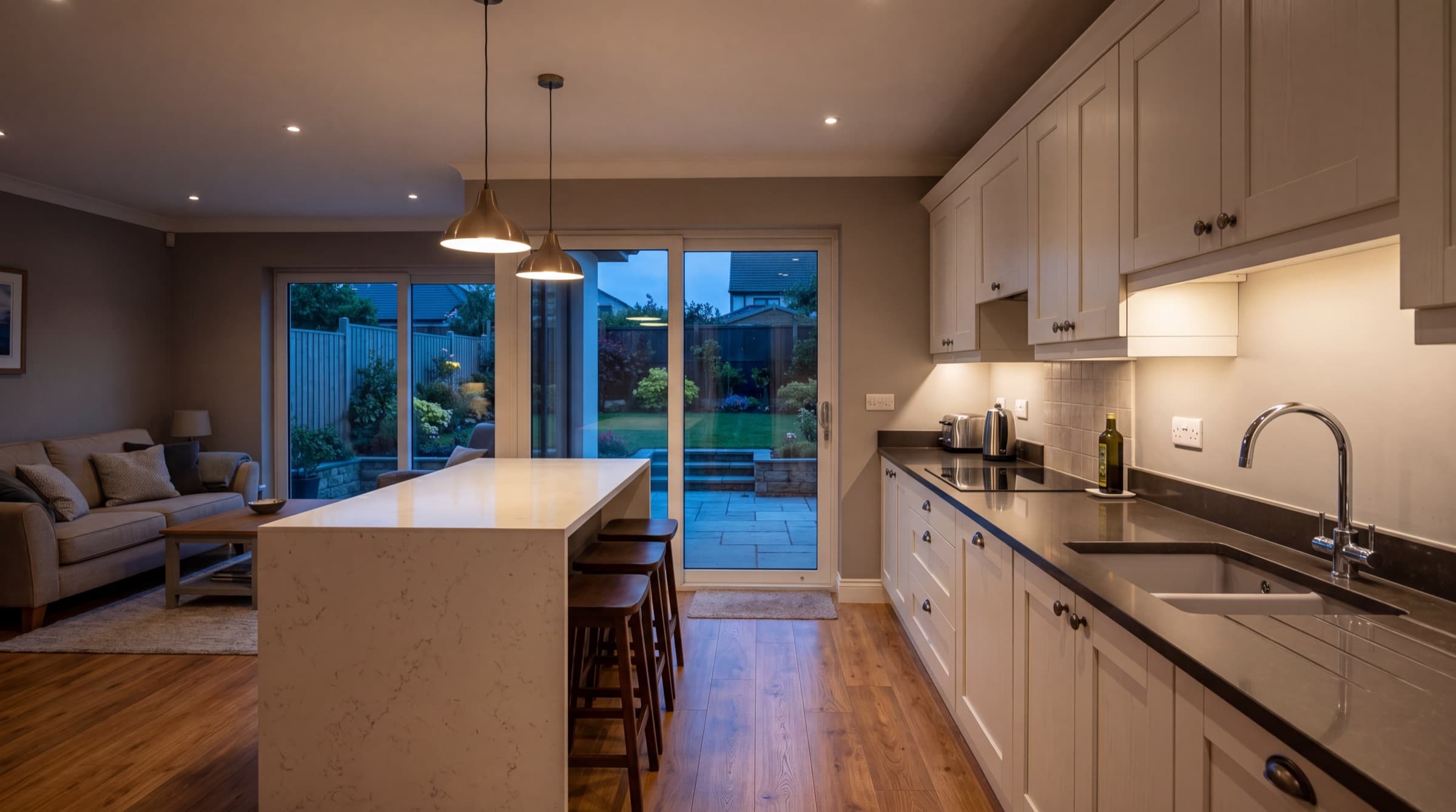
Sockets, switches, lighting, fuse boards, EV, testing. Every room, one standard.
What Domestic Work Covers
Six kinds of job, and the thing worth knowing about each
Not a list of services, but the specific detail that tends to decide the cost or cause the regret. Where a subject has a page of its own, we say so rather than repeating half of it here.
Sockets and small power
Adding a socket is rarely just adding a socket. The question is whether the existing circuit can carry it. A spur off a nearby socket is quick and cheap, but there are limits on what can hang off one, and a kitchen full of high-draw appliances usually wants its own circuit rather than another spur. Kitchens, home offices and garden rooms are the three places where people most often find that what they wanted needs a new circuit back to the board. We will tell you which it is before quoting, because the difference between the two is most of the price.
Common jobs: additional sockets, USB and USB-C outlets, outdoor weatherproof sockets, dedicated appliance circuits, garden room and shed supplies.
Lighting and switching
Lighting is where most of the avoidable regret lives, because the decisions are cheap before the ceiling closes and expensive afterwards. Two-way and intermediate switching so you are not walking through a dark room to reach a switch. Dimmer compatibility is the other one: a lot of LED lamps flicker on dimmers designed for filament bulbs, and the fix is matching the dimmer to the lamp rather than replacing the lamps. Downlights need fire-rated fittings where they penetrate a ceiling, and they need clearance from insulation, which is a real constraint in a modern well-insulated house.
Common jobs: new lighting circuits, downlights, two-way and intermediate switching, dimming, outdoor and security lighting, garden and driveway lighting.
Fuse boards and consumer units
The consumer unit is the part of the installation people can actually see, so it takes the blame for problems that live elsewhere. A modern board with RCD or RCBO protection on every circuit is a genuine safety improvement, and it also means a fault takes out one circuit instead of the whole house. But changing the board does not fix bad wiring behind it. It protects you from it better and, quite often, reveals it. We test before quoting a board change for that reason.
Common jobs: consumer unit replacement, adding RCD or RCBO protection, additional circuits, main earthing and bonding upgrades, surge protection.
What a fuse board upgrade costs in 2026EV charging at home
A home charger install is usually a half-day to a day once the route is agreed. The variables are the distance from the board to where the car parks, whether the existing consumer unit can take a dedicated RCBO-protected circuit, and whether your incoming supply has the headroom. The SEAI home charger grant is worth up to €300 and we handle that paperwork. Where a job goes over budget it is almost always because the board needed upgrading first, which is worth establishing before you order a charger.
Common jobs: tethered and untethered charger installation, dedicated RCBO circuit to I.S. 10101, board upgrades to accommodate a charger, SEAI grant paperwork.
EV charger installationTesting, inspection and certification
Two different documents get called "the cert" and they are not interchangeable. A Completion Certificate is issued after work is carried out and confirms that work meets the national wiring rules. A Periodic Inspection Report is a condition report on an installation that already exists. It grades what is there rather than certifying new work. Which one you need depends entirely on why you are being asked for it, and a lot of the advice online is written for the UK system rather than the Irish one.
Common jobs: Periodic Inspection Reports, pre-purchase surveys, Completion Certificates for work carried out, remedial work after a report.
Testing and certificationFull and partial rewires
A rewire is not one job. It is four or five different jobs that share a name, and which one you are actually facing is decided by when the house was built. A 1950s house with rubber-insulated cable is a different proposition to a 2004 semi where the wiring is sound and the board is at its upgrade point. That is why our rewire pages are organised by era rather than by county: the regulations are national, but the house is not.
Common jobs: full rewires, partial rewires, upstairs-only or kitchen-only rewires, rewire plus board change, making good after.
Rewires by house eraBefore You Call Anyone
If the power is off completely, it may not be an electrician’s job
This is the most common wasted call-out there is, and it is worth two minutes of your time to rule out. An electrician is responsible for the installation inside your house. Everything on the network side of your meter (the supply cable, the service fuse, the meter itself) belongs to ESB Networks, and an electrician cannot legally work on it. If the fault is out there, calling us costs you money and changes nothing.
Three checks separate the two. First, look outside: if the neighbours are dark too, it is a network outage and there is nothing wrong with your house at all. Second, look at your board: if a breaker or the RCD has tripped, the fault is inside and it is ours. Third, if nothing has tripped, the neighbours have power, and your board is completely dead, the problem is most likely between the network and your board, which is ESB Networks again.
Where it is genuinely inside the house and something has tripped, the switch that went is telling you where to look. Our fault finder walks you through narrowing it to a circuit before anyone gets called out, which usually means we arrive knowing what we are dealing with.
Network fault or outage
ESB Networks: 1800 372 999
24 hours. Free to call. The right number when the whole street is out, or when nothing at your board has tripped.
Something tripped
That is inside the house, and ours
Work through the fault finder first. It narrows the circuit in a couple of minutes.
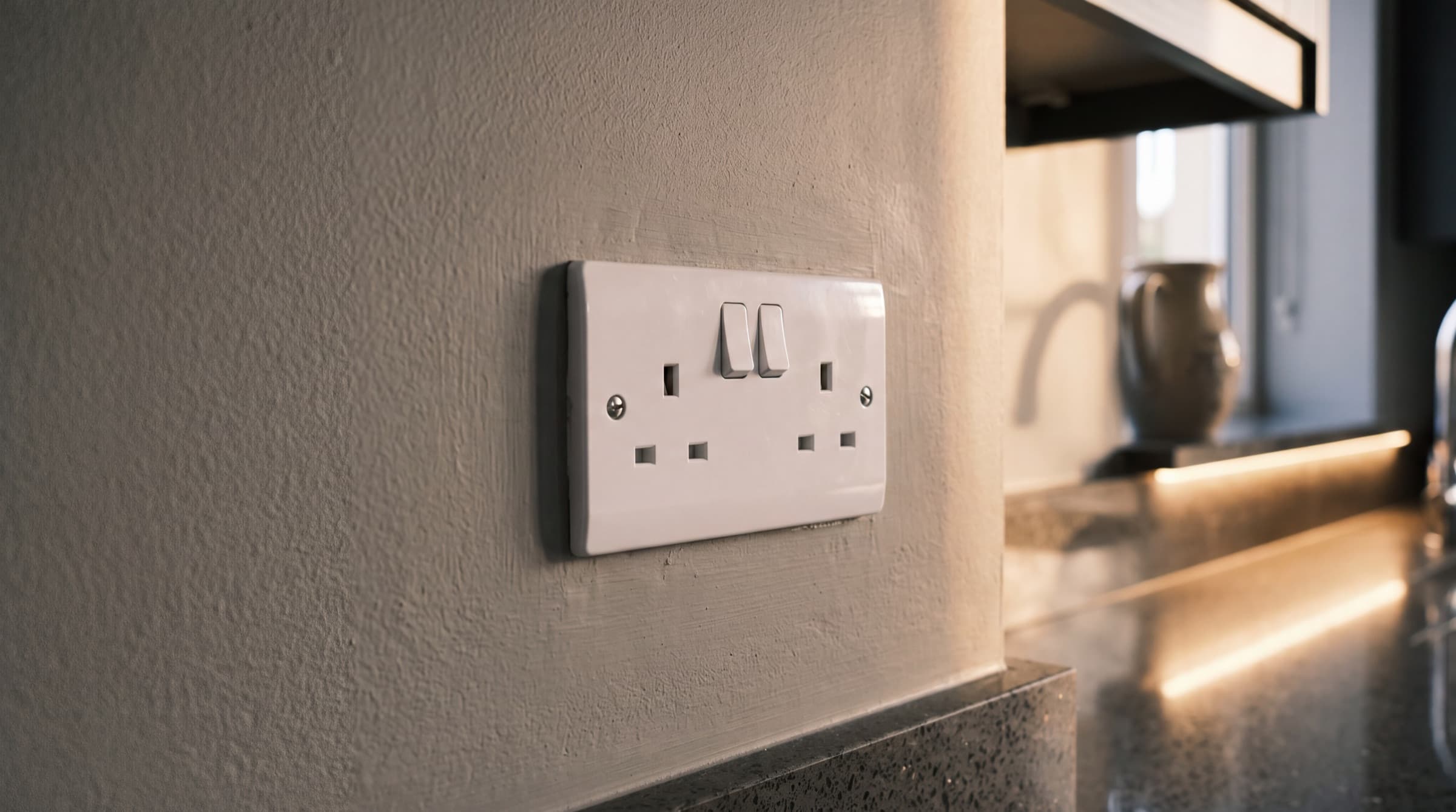
The detail you can see is the standard you can't.
Sockets sit flush. Faceplates are level. Cables run on the cardinal points, straight up, down or across from the accessory, so that anything drilled into that wall in five years' time does not find a cable. None of that is visible once the job is finished, which is exactly why it is the part worth checking. Every circuit tested, the installation certified to I.S. 10101, and the Safe Electric Completion Certificate handed over on the day we finish.
The Process
What actually happens, from the first message to the certificate
Tell us what you noticed
A WhatsApp message with a photo of the board and a description of the problem gets you further than a form. We reply within the hour on weekdays. For anything diagnostic, the more specific you are about when it happens the better. A trip that only happens when the shower runs is a different investigation to one that happens at random.
We look before we price
For small works we can often quote from a description and photos. For anything involving existing wiring, a board change or a rewire, we test first. A price given without testing is a guess, and the gap between the guess and the real number is exactly what people mean when they complain about quotes changing.
A fixed price in writing
Within 48 hours, in writing, with what is included stated explicitly, particularly making good, which is the single biggest reason two quotes on the same job look different. If something genuinely unforeseeable turns up behind a wall, you hear about it before it becomes a cost, not after.
The work, and the state we leave it in
Dust sheets down, cables run on the cardinal points so anything drilled later does not hit them, sockets and faceplates sat flush and level, and the place swept before we go. Most domestic jobs are a day or two. A full rewire on a three-bed is typically five to eight working days for a team of two.
Tested, certified, documented
Every circuit tested, the installation certified to I.S. 10101, and the Safe Electric Completion Certificate handed to you on the day we finish rather than posted at some point afterwards. Keep it. A buyer's solicitor will ask for it, and so will the next electrician who works on the house.
Comparing Quotes
Ask every quote the same question: does it include making good?
If two electricians price the same job and one is noticeably cheaper, this is the first thing to check. Running a new cable into an existing wall means chasing: cutting a channel into the plaster, laying the cable in, and covering it. Putting that wall back to a decorated finish is filling, skimming, drying time and paint. It is real work with a real cost, and it is entirely legitimate to leave it out of an electrical quote as long as everyone knows that is what has happened.
What is not legitimate is finding out at the end. So our quotes state explicitly which of three positions applies: chased and made good ready for decoration, chased and left for your own plasterer, or surfaced in trunking with no chasing at all. On a full rewire that single decision can move the total by thousands, which is a large part of why our published rewire range is as wide as it is.
The other honest answer is that some routes avoid the problem entirely. Running through a floor void, an attic or an existing conduit costs almost nothing to make good. Part of what you are paying for on a site visit is someone working out which walls genuinely have to be opened.
Rewire and fuse board prices, with the ranges and what moves them, are on the rewires page and in our house rewire cost guide. We publish real numbers for those because they are comparable between houses in a way that small works genuinely are not.
Who You’re Dealing With
Why this job is safe with us
J Cowman Electrical Contractors has been Safe Electric registered since 2021, with 5 years of certified installations behind every job we quote.
Safe Electric registered
Registration A6700
Verifiable on the public register
Public liability insurance
Up to €6.5M
Cover in place on every job
Crew size
10 electricians
Trading since 2021
Fixed-price quote
Within 48 hours
WhatsApp replies within the hour, Mon–Fri
FAQ
Domestic Electrical: Common Questions
Do you take on small jobs, or only big ones?
Small jobs are most of what we do domestically. A single socket, a light that has stopped working, a board that trips: those are normal calls rather than an imposition. The development work is what gives us the crew size to be able to fit a small job in without it waiting three weeks.
How much does a small electrical job cost?
It depends almost entirely on whether the existing circuit can carry what you want or whether a new one has to run back to the board. That single question can be most of the price. We give a fixed price in writing before anything starts rather than working on a day rate that creeps. For rewires and fuse board work we publish real ranges on the pages for those jobs, because those are comparable between houses in a way that small works are not.
Will you make good after the work?
Ask this of every quote you get, ours included, because it is the most common reason two prices differ. Chasing cable into a wall means cutting the plaster, and putting that back (filling, skimming and decorating) is a real cost that some quotes include and others quietly leave to you. Ours states explicitly which it is. Where a job is priced without decorating, we will say so rather than let you find out at the end.
Can I stay in the house while the work is done?
For most domestic jobs, yes, including a partial rewire, where we work room by room and you keep power everywhere else. A full rewire is different: floors come up, ceilings come down in places, and the power is off for extended periods. Most people move out for a full rewire, or move into one part of the house while the other is done.
How quickly can you come out?
For quotes we reply on WhatsApp within the hour on weekdays and give you a fixed price within 48 hours. For the work itself it depends on what is booked, which is worth asking about directly rather than us publishing a promise here that might not hold in a busy month.
Are you registered, and does it matter for a small job?
It matters for every job. Only a Registered Electrical Contractor can issue a valid Completion Certificate in Ireland, and for anything other than minor works that certificate is a legal requirement rather than an optional extra. We are registered with Safe Electric under registration A6700 and carry full public liability insurance. You can check any contractor's registration on the Safe Electric public register before you let them near your board.
Do you work weekends or evenings?
For emergencies and for jobs where being in the house during the day is genuinely impossible, we can usually work something out. It is worth asking rather than assuming either way.
What areas do you cover for domestic work?
We are based in Wexford and cover Leinster plus Waterford. Wexford and the south-east is our core patch, and we work regularly in Dublin. If you are outside that, tell us where you are and we will give you a straight answer rather than travelling and adding it to the bill.
Related
Go deeper on the thing you came for
Not sure which of these you need?
Send a photo of the fuse board and a line about what is happening. We reply within the hour, Monday to Friday, and we will tell you straight if it is something you do not need us for.
From a Single Rewire to Full Developments: Send Us the Details.
Send us your plans or a quick description. We return a fixed-price quote within 48 hours, no obligation, no sales calls.